
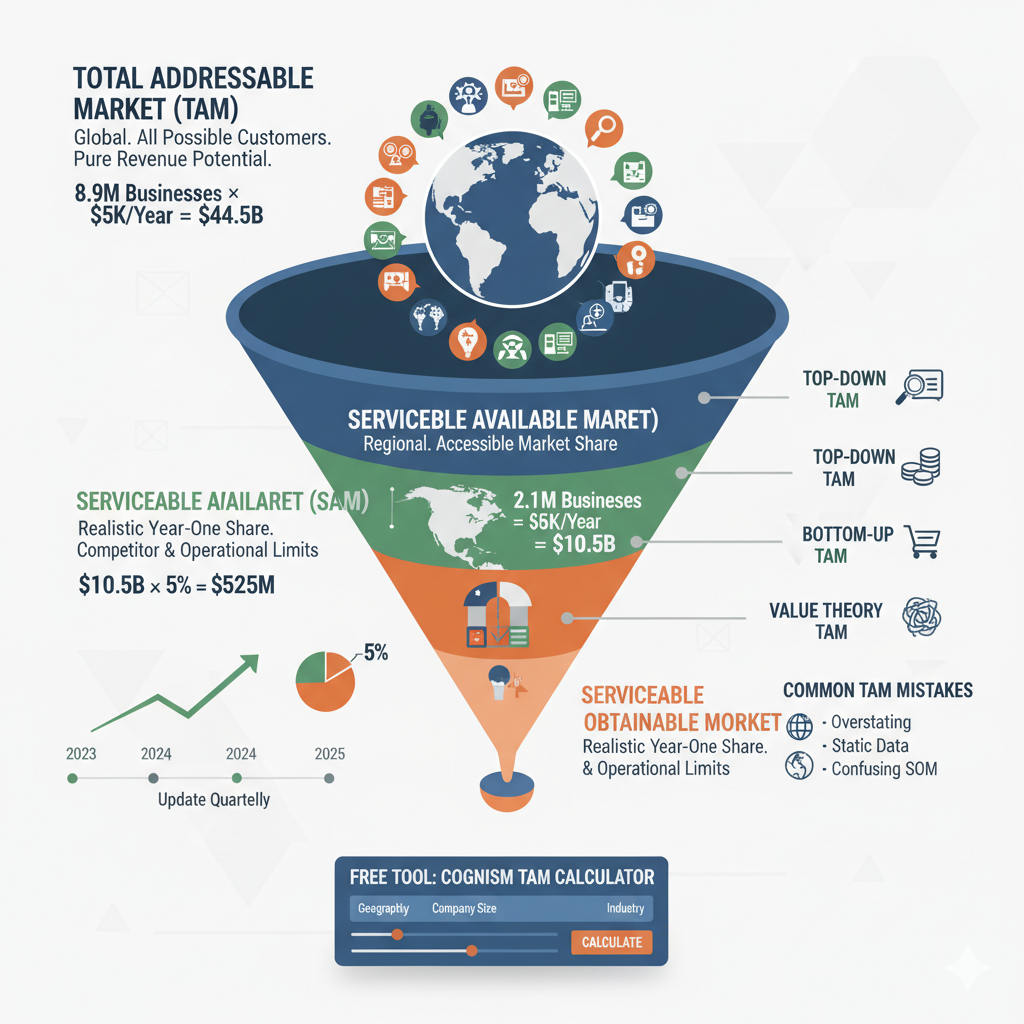
The Total Addressable Market, or TAM, represents the full revenue potential if a company were to capture every possible customer in a market. No competition. No limits. Just the entire pie.
Think of it as the biggest number you can claim when pitching investors or mapping growth. For B2B revenue teams, TAM sets the ceiling. It guides go-to-market strategy and resource allocation. Get it wrong, and your GTM planning falls apart.
This guide breaks down TAM, SAM, SOM, and market sizing. You’ll learn top-down TAM, bottom-up TAM, and value theory TAM. We’ll cover step-by-step TAM calculation, common TAM mistakes, and real-world TAM examples. By the end, you’ll know how to calculate the total addressable market for your B2B SaaS company or early-stage startup.
We’ll also point to the Cognism TAM calculator, a free tool that pulls third-party data and macroeconomic data to speed things up.
What is Total Addressable Market (TAM)?
TAM is the total money available in your market if you won every deal. Think of it as the maximum revenue potential for your product or service. It assumes you reach every ideal customer. It assumes they all pay. It’s not realistic, but it’s useful.
For B2B SaaS companies, TAM is usually measured in annual revenue. A $50 million TAM means the market spends $50 million per year on solutions like yours. That’s the ceiling.
Early-stage startups use TAM to attract funding. Investors want to see a big enough market to justify their check. Scaling teams use it for market expansion. If your current region is tapped out, TAM shows where to go next.
Why Companies Need TAM
Without TAM, decisions come from guesswork. You might chase small segments. You might overspend on low-value leads. You might miss entire markets.
With TAM, you can:
- Pick the highest-value market segments.
- Forecast revenue with real data.
- Align sales and marketing on the same goal.
- Justify the budget for new territories or features.
TAM answers hard questions:
- How big is the opportunity?
- Which regions should we enter?
- Where do we put our sales team?
It’s the north star for GTM planning.
TAM vs SAM vs SOM: The Key Differences
People mix these up. Here’s the simple breakdown.
- Total Addressable Market (TAM): Everyone who could buy. Global. No filters. Pure revenue potential.
- Serviceable Available Market (SAM): The slice you can reach. Geography, regulations, or channels limit it.
- Serviceable Obtainable Market (SOM): What you can realistically grab. Factors include competitor presence, operational constraints, and market share goals.
| Term | Scope | Example (HR Software) |
| TAM | All companies worldwide need HR tools | 8.9M businesses × $5K/year = $44.5B |
| SAM | Companies in North America you can sell to | 2.1M businesses × $5K = $10.5B |
| SOM | 5% you win in year one | $10.5B × 5% = $525M |
TAM is the north star for GTM. SAM narrows focus. SOM sets sales targets.
Why Companies Need TAM
Early-stage startups live or die by TAM. Investors ask, “Is the market opportunity big enough?” A small TAM kills funding chances.
B2B revenue teams use TAM for:
- Sales and marketing alignment
- Forecasting
- Market expansion decisions
- Product development priorities
Without TAM, you guess. With it, you plan.
How to Calculate Total Addressable Market
Three main ways exist. Pick based on data and stage.
1. Top-Down TAM Calculation
Start broad. Use industry reports from Gartner, Forrester, or IDC.
Steps:
- Find total market size (revenue or units).
- Apply your segment percentage.
- Multiply.
Real-world TAM example:
Global HR software market = $37B (Gartner 2024).
Your focus: SMBs under 500 employees (28% of market).
TAM = $37B × 28% = $10.36B.
Fast. Relies on third-party data. Good for early-stage startup pitches.
2. Bottom-Up TAM Calculation
Build from the ground up. Use your pricing and customer count.
Steps:
- Define ideal customer profile (ICP).
- Estimate ICP count in the target market.
- Multiply by annual revenue per customer.
Real-world TAM example (London graduate recruitment agency):
- UK companies hiring grads: 20,000 (primary research).
- Average contract: £30,000.
- Bottom-up TAM = 20,000 × £30,000 = £600M.
Accurate. Needs solid market research. Best for a B2B SaaS company with pilot campaign data.
3. Value Theory TAM Method
Ask: “What value do we create? What are buyers willing to pay?”
Steps:
- Quantify pain solved (time saved, revenue gained).
- Set price as a fraction of value.
- Multiply by addressable customers.
Example:
Your tool saves sales reps 10 hours/week.
Rep cost: $50/hour.
Annual value: 10 × 50 × 50 weeks = $25,000.
Willing to pay 20%: $5,000/year.
ICP count: 500,000 reps.
Value theory TAM = 500,000 × $5,000 = $2.5B.
Forward-looking. Great for product development and buyer behavior insights.
Step-by-Step TAM Calculation (Bottom-Up for B2B SaaS)
Let’s walk through a full example. Say you sell sales intelligence to UK B2B firms with 50–500 employees.
- Define ICP
- UK companies
- 50–500 staff
- £10M–£100M revenue
- Tech, finance, or consulting verticals
- Count ICP Use Cognism or LinkedIn Sales Navigator. Result: 18,500 companies.
- Set Pricing Single fixed fee: £15,000/year.
- Calculate Annual Revenue Potential 18,500 × £15,000 = £277.5M TAM.
- Validate Cross-check with IDC UK SaaS spend data. Adjust for market conditions (recession cuts 10% → £250M).
That’s your bottom-up TAM.
TAM Calculator Free: Try Cognism’s Tool
Manual math works, but tools save time. The Cognism TAM calculator pulls live data from company databases, macroeconomic reports, and buyer behavior trends.
Input:
- Geography
- Company size
- Industry
- Your pricing
Output:
- TAM, SAM, SOM
- Market segments breakdown
- Growth planning projections
Ilse Van Rensburg, Head of Growth at Cognism, built it for B2B revenue teams. No spreadsheets. No guesswork.
Common TAM Mistakes (and Fixes)
- Overstating TAM by claiming global when you only sell locally. Fix: Stick to serviceable markets.
- Ignoring Market Demand, Big TAM doesn’t mean buyers want it. Fix: Run primary research or pilot campaigns.
- Static Numbers Markets shift. 2025 TAM won’t match 2023. Fix: Update quarterly with fresh data.
- Confusing TAM with SOM Pitching $10B TAM but forecasting $10M. Fix: Show the funnel: TAM → SAM → SOM.
- No ICP “Everyone needs this.” No one believes it. Fix: Nail your ideal customer profile first.
TAM for B2B Sales Teams
Sales leaders use TAM to:
- Set quotas
- Prioritize territories
- Align with marketing on lead volume
Example: TAM shows £600M UK opportunity. SAM (London focus) = £180M. SOM (year-one 3%) = £5.4M.
Quota splits evenly across 10 reps = £540K each.
TAM for GTM Strategy
Go-to-market strategy starts with TAM. It answers:
- Which markets first?
- How much to spend on acquisition?
- When to expand?
High TAM + low SAM = focus on distribution.
Low TAM + high SAM = niche domination.
TAM for Early-Stage Startups
Founders need TAM for:
- Seed/Series A decks
- Hiring sales
- Pricing tests
Investors want 10x potential. A $500M TAM rarely cuts it. Aim for $1B+ in B2B SaaS.
TAM for Market Expansion
Entering Europe? Recalculate:
- New ICP count
- Local pricing
- Regulatory SAM cuts
Example: US TAM $2B. EU add-on $1.1B. Total $3.1B.
TAM for Revenue Forecasting
Link TAM to pipeline:
- SOM = 5% of SAM
- Conversion rates
- Sales cycle length
Forecast = SOM × win rate × velocity.
Real-World TAM Example: Cognism Itself
Cognism sells sales intelligence to B2B revenue teams in EMEA and NA.
Bottom-up TAM (2025):
- Target: Companies with 200+ employees, SDR teams.
- Count: 42,000 (Cognism data).
- ARR: £36,000 average.
- TAM = 42,000 × £36,000 = £1.51B.
SAM (EMEA only): 28,000 firms → £ 1 B.
SOM (year-one 4%): £40M.
They hit £30M ARR in 2024. On track.
TAM and Market Research
Good TAM needs:
- Primary research (surveys, interviews)
- Third-party data (Gartner, Forrester, IDC)
- Competitor analysis
Blend all three. One source lies.
TAM in Product Development
Build for the biggest pain in your TAM.
Example: 60% of ICP struggles with data compliance.
Launch compliance module first.
TAM and Resource Allocation
Big TAM doesn’t mean spray and pray.
Allocate:
- 70% to core SAM
- 20% to the adjacent expansion
- 10% to moonshots
TAM and Funding
VCs screen TAM fast.
Under $1B? Pass.
$1B–$5B? Maybe.
$5B+? Deep dive.
Show calculation. Back it with data. Name sources.
Frequently Asked Questions
What is the total addressable market (TAM)?
The full revenue a product could generate if it won 100% of the market.
How to calculate the total addressable market?
Top-down (reports), bottom-up (customers × price), or value theory (value created × willingness to pay).
Top-down TAM calculation example?
Global cloud market $680B. Your share (SMB collaboration) is 12%. TAM = $81.6B.
Bottom-up TAM calculation example?
15,000 ICP firms × $40,000 ARR = $600M TAM.
Value theory TAM method?
The tool saves $100K/year. Customers pay 15%. 50,000 prospects. TAM = $750M.
TAM calculator free?
Yes. The Cognism TAM calculator is free. Input ICP, get TAM/SAM/SOM instantly.
Why do companies need TAM?
Sets vision. Guides strategy. Wins funding. Aligns teams.
TAM for B2B sales teams?
Defines quota potential and territory priority.
TAM for GTM strategy?
Shows where to focus the budget and messaging.
TAM for early-stage startups?
Proves market size to investors.
TAM for market expansion?
Quantifies new geography or vertical opportunity.
TAM for revenue forecasting?
Feeds pipeline models and growth planning.
Final Thoughts on Market Sizing
TAM isn’t a trophy number. It’s a tool.
Use it to make strategic decisions.
Update it often.
Ground it in data.
B2B SaaS companies live by revenue potential. Early-stage startups die without a market opportunity. Get TAM right, and everything, GTM planning, sales, and marketing alignment, funding falls into place.
B2B lead generation resources help you build better lists. They show tactics. They offer tools. But good ones hide in plain sight.
You need guides on hiring reps. Courses on demand generation. Templates for emails.
This piece shows where to look. It points to free and paid options. Updated for November 2025.
Let’s walk through it.
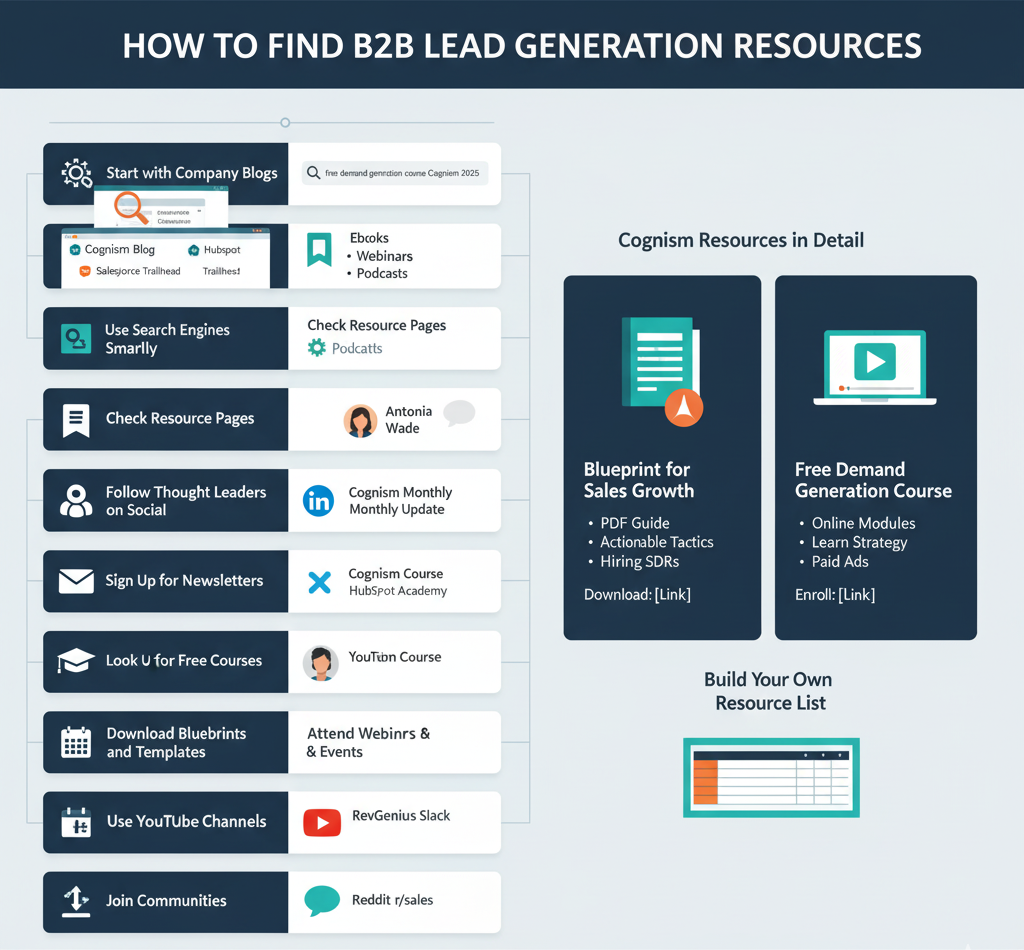
Start with Company Blogs
Most B2B companies share free content. Cognism posts guides. HubSpot runs a blog. Salesforce has Trailhead.
Search “B2B lead generation Cognism”. Find their resource hub. It lists ebooks, webinars, and podcasts.
Why start here? Content ties to real tools. Cognism sells data. Their blueprint for sales growth shows how they use it.
HubSpot offers a free demand generation course. Modules cover paid ads, campaigns, and B2B lead generation tools.
Sign up with your email. Download right away.
Use Search Engines Smartly
Google holds answers. Type long questions.
Try “free demand generation course Cognism”. The top result links to the course.
Or “blueprint for sales growth”. Cognism’s PDF appears.
Add “2025” for fresh content. “B2B lead generation resources 2025”.
Filter by date. Click Tools > Past year.
This cuts old advice. Buyers have changed since 2023. Resources must match.
Check Resource Pages
Many sites have a /resources section. Cognism’s page lists:
- Blueprint for sales growth
- Free demand generation course
- Webinars on outbound
Bookmark these. Visit monthly. New items drop often.
Salesforce Trailhead has free modules. Search “lead generation”.
LinkedIn Learning offers paid courses. Free trial gives 30 days.
Follow Thought Leaders on Social
X and LinkedIn share links fast. Follow Cognism. They post new resources.
Kyle Coleman shares sales tips. Antonia Wade talks buyer journeys.
Search hashtags. #B2BLeadGen #DemandGeneration.
Reps post templates. Save them.
Join groups. Revenue Operations Alliance shares free tools.
Sign Up for Newsletters
Newsletters are delivered to your inbox. Cognism sends monthly updates. New course? You hear first.
Pavilion offers a weekly digest. Links to playbooks.
Unsubscribe if spam. Keep three good ones.
Look for Free Courses
Free demand generation course from Cognism covers the basics. Paid ads. Campaign setup. Tools.
HubSpot Academy has lead gen tracks. Certificates at the end.
Coursera partners with universities. Search “B2B marketing”.
Time it right. One hour a week. Finish in a month.
Download Blueprints and Templates
Blueprint for sales growth from Cognism is a PDF. Covers hiring. Training. Forecasting.
Print it. Mark sections. Use for team meetings.
Search “sales playbook template”. Find free versions on Google.
Edit in Google Docs. Add your ICP.
Attend Webinars and Events
Webinars give live Q&A. Cognism runs monthly. Topics like ABM or cold email.
Register free. Recording comes later.
Events like SaaStr share decks. Download after.
Use YouTube Channels
Cognism YouTube has short videos. “How to build a sales team”.
Search “B2B lead generation tutorial”. Sort by view count.
Subscribe. Turn on notifications.
Join Communities
Slack groups like RevGenius share resources. Ask for “best free demand gen course”.
Reddit r/sales has threads. Search “lead gen resources”.
Answer questions. Build your list.
Paid Options When Ready
Gartner reports cost money. Worth it for big teams.
LinkedIn Premium shows who viewed your profile. Helps prospecting.
Start free. Upgrade later.
Cognism Resources in Detail
Cognism offers two standouts.
Blueprint for sales growth
PDF guide. Actionable tactics. Hiring SDRs. Training on tools. Forecasting pipeline.
Download here: Cognism Blueprint
Free demand generation course
Online modules. Learn the marketing strategy Cognism style. Covers paid ads, B2B lead generation tools, and campaigns.
Enroll here: Cognism Course
Both updated 2025. New AI sections.
Build Your Own Resource List
Make a Google Sheet. Columns: Name, Type, Link, Notes.
Add Cognism blueprint. Note “hiring section strong”.
Review quarterly. Delete dead links.
Common Mistakes to Skip
Downloading everything. Pick one. Finish it.
Ignoring dates. Old playbooks miss AI.
Paying early. Free options cover 80%.
Step-by-Step Plan
- Search “B2B lead generation resources Cognism”.
- Download the blueprint for sales growth.
- Enroll in a free demand generation course.
- Watch one webinar.
- Save three templates.
- Review in 30 days.
Start small. One resource a week.
Why These Resources Work
They come from practice. Cognism uses them daily. Clients see results.
A logistics firm followed the blueprint. Hired five SDRs. Booked 40 demos in Q1.
You can too.
Keep It Fresh
Set a calendar reminder. First of each month. Search for new B2B lead generation resources.
Follow Cognism on LinkedIn. New course drops? You know.
Final List of Starting Points
- Cognism Resource Hub
- HubSpot Academy
- Salesforce Trailhead
- LinkedIn Learning (free trial)
- RevGenius Slack
- YouTube: Cognism channel
Internal links:
B2B Lead Generation Tools
Sales Team Hiring Guide
FAQ:
What are B2B lead generation resources, and why do they matter?
They’re guides, courses, templates, and tools that help you find and work with better leads, like ebooks on hiring SDRs or playbooks for demand gen campaigns. They matter because they cut the trial-and-error. A good resource, like Cognism’s blueprint, shows real tactics from teams hitting $50M ARR. In 2025, with AI changing everything, fresh ones keep you ahead; old advice misses things like intent signals from web searches.
Where should I start looking for free B2B lead generation resources?
Hit company blogs first, they’re packed with free stuff tied to real products. Cognism’s resource hub has ebooks, webinars, and podcasts on lead gen. HubSpot’s blog offers a free demand generation course with modules on paid ads and tools. Salesforce Trailhead has lead gen modules too. Just search “B2B lead generation [company]” top results usually link straight to downloads. It’s quick, and you get context from folks who use the tools daily.
How do I use search engines to find the best B2B lead generation resources?
Type specific questions to cut noise. “Free demand generation course Cognism” pulls up their 8-module playbook, refreshed for 2025 with AI tips on SEO and webinars. For blueprints, try “blueprint for sales growth.” Cognism’s PDF covers hiring to forecasting. Add “2025” for current hits, like Headley Media’s free planning toolkit with templates and checklists. Filter results by date in Google (Tools > Past year) to skip 2023 relics buyers now expect personalized, data-backed tactics.
What are some top free courses for B2B lead generation in 2025?
Cognism’s free demand generation course is a standout. It’s an 8-module deep dive on campaigns, paid ads, and tools, straight from their playbook that scaled them to $50M ARR. HubSpot Academy has lead gen tracks with certificates; start with their inbound basics. Coursera’s B2B marketing courses, often free via audit, partner with universities for strategy modules. Pace yourself one hour a week, and you’re done in a month. These beat generic YouTube vids because they include templates you can tweak.
What’s the Cognism Blueprint for sales growth, and how do I get it?
It’s a free PDF roadmap from Cognism on building a predictable revenue engine that covers outbound models, hiring SDRs 37% faster than average, and forecasting systems they used to hit $50M ARR. Download it from their site (cognism.com/resources); it’s updated for 2025 with AI sections on pipeline stages. Print it out, highlight the hiring part, and use it in team huddles. Clients like logistics firms booked 40 demos in Q1 after following it.
How can I find B2B lead generation templates and blueprints?
Search “sales playbook template” on Google for free Google Docs versions, edit in your ICP details. Cognism’s blueprint is a prime example: actionable steps from hiring to an eight-step sales process. Headley Media’s 2025 toolkit has Excel/Google Sheets planners and checklists, too. Start with one, like a nurture sequence template, and test it on 50 leads before scaling.
What social media spots are good for discovering B2B lead generation resources?
Follow thought leaders on LinkedIn and X. They drop links constantly. Cognism shares new playbooks; Kyle Coleman posts sales tips; Antonia Wade covers buyer journeys. Search hashtags like #B2BLeadGen or #DemandGeneration for templates from reps. Join groups: Revenue Operations Alliance on LinkedIn for free tools, or RevGenius Slack for course recs. Save what you find, answer a post to build your network too
B2B lead generation keeps companies growing. It finds the right contacts. It starts conversations. But strategies change fast. Buyers expect more. Sales teams need better tools.
Thought leaders share what works. Their views come from real experience. They spot trends early. They fix common problems.
This piece pulls from two experts. Kyle Coleman, former SVP of Marketing at Clari. Antonia Wade, Global CMO at PwC. Both talked with Cognism leaders.
Their insights touch on outdated ideas. They cover buyer shifts. They offer steps for B2B marketers.
Updated as of November 2025, these points stay fresh. Buyers still demand value. Funnels still fail if not fixed.
Let’s look at what they say.
Why Influencer Insights Matter in B2B Lead Generation
Influencer insights guide your B2B lead generation strategy. Experts like Kyle and Antonia test ideas in big companies. Clari scales revenue tech. PwC serves global clients.
Their advice cuts through noise. You avoid old traps. You build plans that fit now.
For example, 70% of B2B buyers research alone before sales talks. Insights help you meet them there.
These talks happened in 2023. But core ideas hold. In 2025, AI adds layers. Buyers use tools for quick checks. Marketers must adapt.
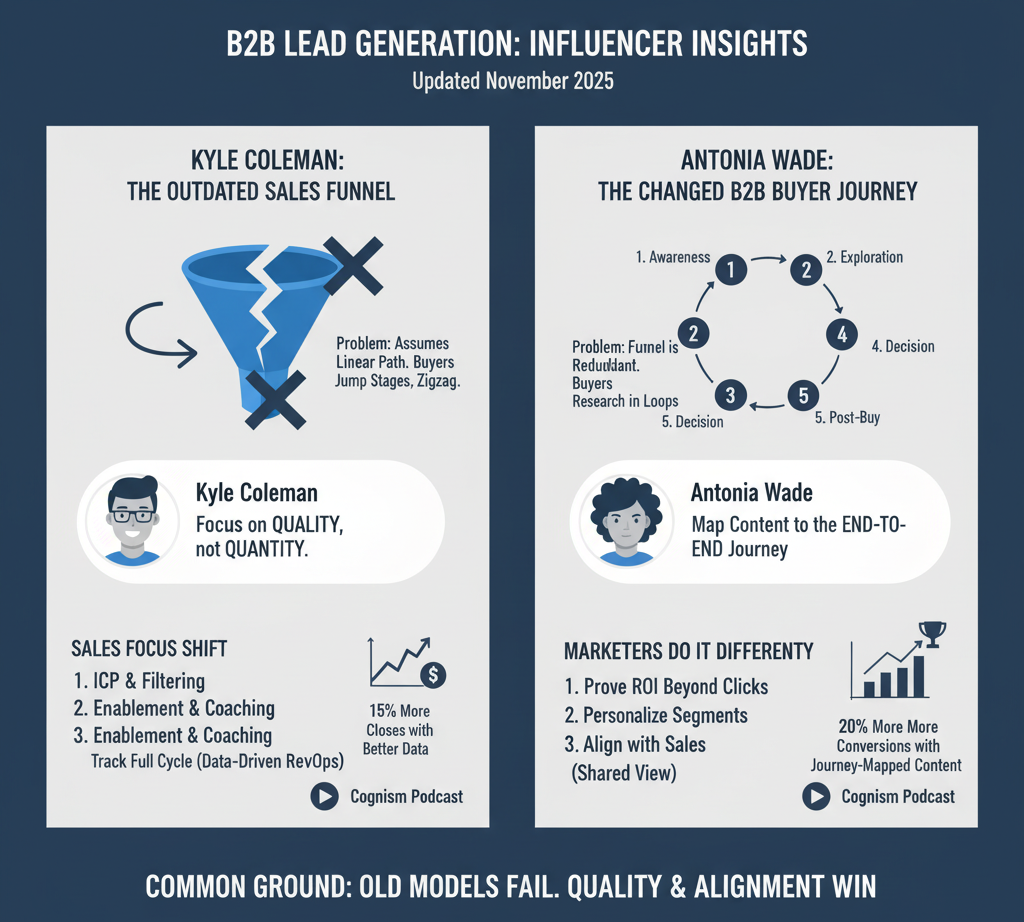
Kyle Coleman on the Outdated Sales Funnel
Kyle Coleman led marketing at Clari. He grew teams from small startups. Looker went from six people to 800. Acquired by Google in 2019.
Now at Copy.ai, he still shapes B2B sales. Cognism’s sales leaders asked him: Why has the sales funnel become outdated?
The funnel assumes a straight path. Awareness of interest in the decision. But real B2B sales zigzags.
Buyers jump stages. They compare options mid-way. One contact drops out. Three more join.
Kyle says focus on quality, not quantity. Sales departments chase too many leads. Low-fit ones waste time.
At Clari, they shifted. They built a revenue process. Not just a funnel. Pipeline shows risks early. AI spots stalled deals.
This means better B2B sales leads. Fewer cold calls to wrong fits. More meetings with ready buyers.
Kyle’s tip: Track the full cycle. From first touch to renewal. Use data to see gaps.
In 2025, tools like Clari’s platform predict closings. But without quality focus, numbers lie.
How Sales Departments Can Focus on Quality, Not Quantity
Sales departments often measure calls made. Emails sent. Leads generated.
Kyle pushes back. Quality, not quantity, builds trust. One good conversation beats 50 bad ones.
Start with your ICP. Ideal customer profile. Who truly needs you? Filter lists are tight.
At Clari, they used enablement. Short videos for reps. Self-guided training. Cut long sessions.
Result? Reps handle complex sales. They qualify faster.
For a B2B lead generation strategy, this shifts outbound. Personalize fewer touches. Deepen them.
Kyle notes: Pipeline is a black box for many. Open it with visibility. See where leads leak.
Sales leaders gain confidence. Forecasts improve. Teams hit quotas.
In practice, a Clari client saw 15% more closes. From better data, not more volume.
Applying Kyle’s Ideas to Your Team
Take Kyle’s words. Audit your sales funnel. Is it linear? If yes, map real paths.
Talk to reps. Where do they lose time? Fix those spots.
Add tools for quality. CRM with scoring. AI for intent signals.
Cognism sales leaders talked with Kyle Coleman in a podcast. Listen for full details. It covers RevOps, too.
This builds your B2B lead generation. Steady, not frantic.
Antonia Wade on the Changed B2B Buyer Journey
Antonia Wade leads marketing at PwC. Global CMO since 2021. Before that, Capita, Thomson Reuters, and Accenture.
She wrote Transforming the B2B Buyer Journey in 2023. It challenges old models. Won praise in 2024.
Cognism’s CMO, Alice de Courcy, interviewed her. Question: How has the B2B buyer journey changed?
Antonia says the funnel is redundant. Buyers don’t flow down. They explore in loops.
High-stakes buys involve more people. CFO checks the budget. IT reviews security. Legal scans terms.
This slows things. But it builds buy-in.
Changes? Digital first. Buyers self-educate. 60% finish research before contact.
Antonia’s framework has five parts. Not a funnel. Stages for decision types.
- Awareness: Spot need.
- Exploration: Research options.
- Evaluation: Compare fits.
- Decision: Align stakeholders.
- Post-buy: Onboard and retain.
B2B marketers must map to this. Create content for each stage.
Her book has templates. Case studies from PwC, Salesforce, and EY.
In 2025, AI speeds research. Buyers use chatbots for specs. Marketers need precise answers.
What B2B Marketers Can Do Differently
Antonia urges change. Ditch short-term leads. Build long-term value.
What can B2B marketers do differently? Focus on the journey end-to-end.
Prove ROI beyond clicks. Track loyalty. Repeat business.
At PwC, they run campaigns across channels. Consistent themes. Memorable brand.
Antonia warns: Economic gloom slows pipelines. Be cautious. Add precision.
Use data for segments. Tailor messages. Avoid generic blasts.
Her interview with Alice de Courcy covers this. From Cognism’s podcast.
Link:
Key: Align sales and marketing. Shared journey view. No handoffs in voids.
Antonia’s Framework in Action
Apply her ideas. Audit your content. Does it match buyer stages?
For exploration, share guides. “How to cut compliance costs.”
For evaluation, offer demos. Side-by-side comparisons.
Post-buy, send tips. Build loyalty.
A PwC case: Campaign for audit tools. Journey-mapped. 20% more conversions.
In 2025, add AI. Personalize at scale. But keep a human touch.
Antonia’s book updates in the 2025 edition. New AI chapter.
Connecting Insights to B2B Lead Generation Strategy
Kyle and Antonia agree: Old models fail. Funnels ignore reality.
Combine their views. Quality leads through journey awareness.
For B2B lead generation influencer insights, this duo shines. Kyle on sales ops. Antonia on marketing depth.
Thought leaders in B2B sales and marketing like them push progress.
Insights to level up B2B lead generation: Test small. Measure real impact.
Why the Sales Funnel Became Outdated
Buyers changed. They control the pace. Funnels assume push. Reality is pull.
Kyle: Black box pipelines hide issues. Open them.
Antonia: Nuances matter. Five stages fit better.
Sales departments focus on quality, not quantity. Fewer, better leads.
How has the B2B buyer journey changed? More stakeholders. Digital loops.
Fresh Takes in 2025
As of November 2025, trends build on these. AI in funnels. Predictive scoring.
Antonia was named Marketer of the Year 2024. Her ideas spread.
Kyle at Copy.ai uses them for AI copy in sales.
B2B marketers do it differently: Listen to buyers. Adapt fast.
Tools and Next Steps
Start with podcasts. Hear full talks.
Read Antonia’s book. Get templates.
Join the Cognism community. Share your journey.
Internal link: B2B Lead Generation Strategies
For images, add alt text: “Kyle Coleman discussing sales funnel at Clari event, 2023.”
This keeps content accessible.
Final Thoughts
Influencer insights like these ground your work. No fluff. Just tested paths.
B2B lead generation thrives on quality. Journey focus. Real alignment.
Try one idea. From Kyle or Antonia. Watch your pipeline clear.
Questions? Comment below.
FAQ:
How does B2B lead generation drive revenue?
It connects you to qualified prospects who close faster. One good deal can cover a year’s worth of data tools. Focus on quality, and strangers become repeat customers, fueling steady growth.
What are common mistakes in B2B lead generation?
- Buying cheap, unverified lists leads to bounces and blacklists.
- Ignoring compliance laws like GDPR risks huge fines (up to €20 million).
- Treating all leads in the same segment by role and pain points.
- Quitting after one touch, most deals need seven to ten.
- Skipping data cleanup, contacts change jobs every two to three years. Avoid these, and your efforts pay off quicker.
How do I start or improve B2B lead generation?
Follow these steps:
- Define your ICP (ideal customer profile): company size, revenue, industry, and key titles.
- Choose a data provider that matches, checking coverage and compliance.
- Set up lead scoring for fit and behavior.
- Align sales and marketing on what a qualified lead looks like.
- Track metrics like cost per lead and revenue generated.
- Review everything monthly and tweak what isn’t working. Start small; one change at a time.
What stats show B2B lead generation?
- Verified data gives 3x higher reply rates on cold outreach.
- Aligned sales and marketing teams close 36% more deals.
- Accurate mobile numbers boost connect rates by 400%.
- Compliant lists dodge average GDPR fines of €1.2 million per breach. These come from real teams using clean processes.
What resources are good for B2B lead generation?
Check these: B2B contact databases for comparisons, data sourcing tips for legal builds, lead enrichment guides for CRM fixes, TAM calculators for quick estimates, compliant checklists for safety, top platforms to buy leads with pros/cons, and case studies on scaling from 50 to 500 leads a month. Most are free downloads.
What’s the difference between a sales lead and a prospect?
A sales lead has shown some interest, like filling out a form. A prospect fits your profile and engages more actively. Qualified B2B prospects then become SQLs ready for deeper talks.
How does pipeline management fit into B2B lead generation?
It keeps your funnel moving—watching stages to spot stalls and push leads forward. Good management cuts customer acquisition costs and boosts revenue generation through a consistent flow.
What is sales enablement in B2B?
It’s giving your team the right tools, like scripts, decks, or case studies, to sell faster. This supports closing deals by making reps more confident and prepared.
B2B lead generation technology finds the right contacts. It sends messages. It tracks every reply. It keeps your team on track.
Tools handle the heavy lifting. You focus on the talks that close deals.
Here is what works, broken down by job.
Why Technology Matters for B2B Lead Generation
Manual lists take hours. Wrong emails bounce. Forgotten follow-ups lose deals.
Technology for B2B lead generation fixes that. It pulls data. It automates outreach. It shows results in real time.
B2B sales technology and B2B marketing technology work together. Sales pushes. Marketing pulls. Both feed the pipeline.
A solid setup cuts lead costs. It books more meetings. It grows revenue.
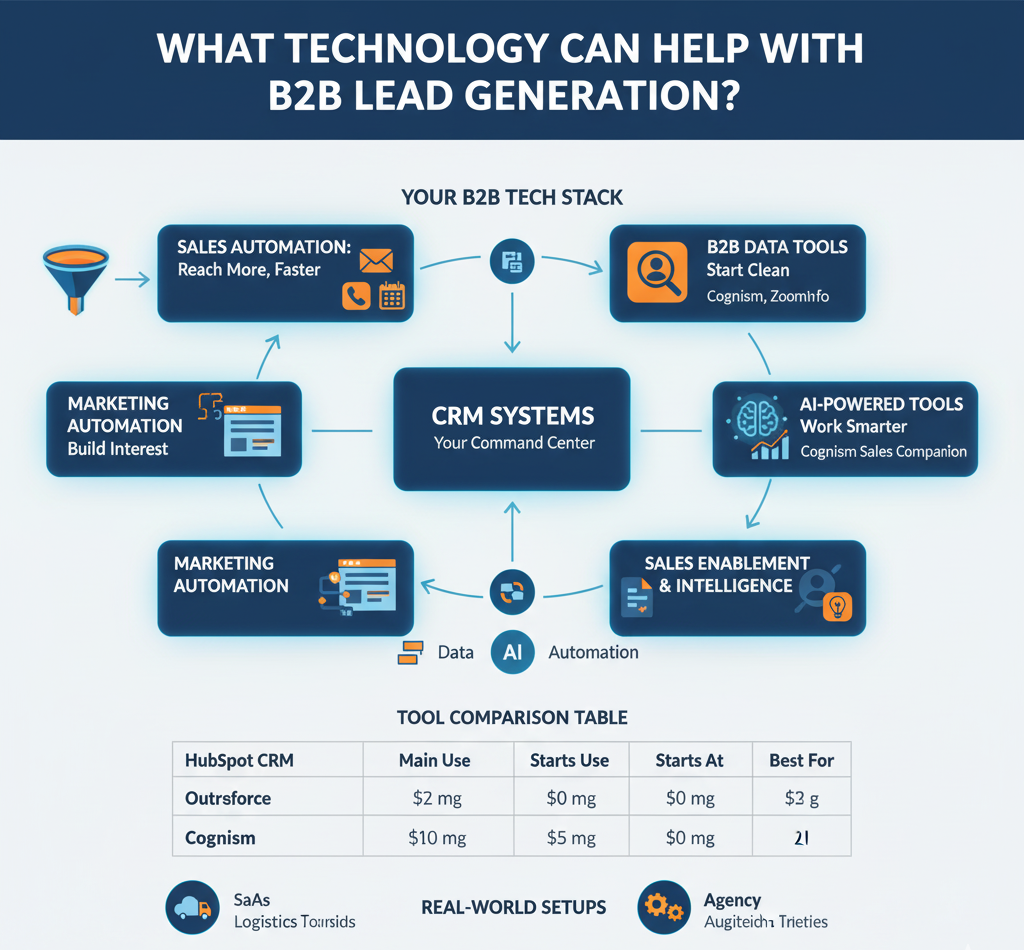
CRM Systems: Your Command Center
Start with a CRM. It holds every contact. It logs every call. It reminds you of what is next.
CRM systems track the full path. Form fill to closed deal.
HubSpot CRM costs nothing to begin. Salesforce scales for big teams. Pipedrive stays simple.
Lead capture forms on your site feed the CRM. Someone downloads a guide. The lead lands in the system.
CRM integration links tools. Connect email. Add a calendar. Pull in data.
CRM data analysis spots patterns. Which source brings the best leads? Which email gets clicks?
This improves customer relationships. You see past notes before you call.
SaaS-based CRM runs online. Log in from phone or laptop. No IT headaches.
Lead management systems inside the CRM route contacts. New inbound lead goes to the right rep.
Sales Automation: Reach More, Faster
Sales automation handles repetition. It sends emails. It dials numbers. It schedules calls.
Outbound email automation personalizes hundreds of messages. Add name. Insert company revenue. Send.
Cold calling automation queues calls. Tools like Outreach Dial. You talk when someone answers.
B2B automation tools free reps. No more copying names into spreadsheets.
Prospecting automation adds fresh contacts daily. Set your filters. Check new leads each morning.
Sales pipeline automation moves deals. Lead stalls? Send a nurture email.
These tools boost B2B sales efficiency. Reps spend time on conversations, not admin.
Marketing Automation: Build Interest
Marketing automation nurtures leads. It sends the right email at the right time.
A contact visits your pricing page. The system starts a sequence. Day 1: case study. Day 3: invite to webinar.
Customer engagement software tracks behavior. Opens. Clicks. Downloads.
This is lead nurturing technology. Keep leads interested without constant work.
Sales and marketing automation software must connect. Shared data means no silos.
B2B sales and marketing alignment starts here. Same dashboard. Same goals.
B2B Data Tools: Start Clean
Data is the foundation. B2B data tools provide accurate contacts.
Cognism delivers verified emails and phones. ZoomInfo adds company details.
Lead enrichment software completes records. Name and title become a full profile.
Data-driven B2B marketing needs fresh info. Old emails hurt deliverability.
B2B sales leads management stays organized. Tag leads by source. Score by fit.
Outbound prospecting tools export lists. Import to your CRM. Start outreach.
AI-Powered Tools: Work Smarter
AI-powered B2B lead generation predicts outcomes. It scores leads. It suggests the next steps.
AI sales technology reads patterns. This contact opened every email. Call now.
Machine learning in lead generation ranks prospects. Focus on high scores first.
Smart sales automation drafts replies. “Try this subject line.”
Cognism Sales Companion shows intent. It flags companies searching your category.
Cognism AI technology pulls signals from the web. No guesswork.
AI needs clean data. Feed it good contacts for accurate tips.
Sales forecasting tools use AI. See next quarter’s revenue today.
Sales Enablement and Intelligence
Sales enablement software stores assets. Battle cards. Pricing sheets. One click to add.
Sales intelligence software digs deep. See tech stack. View funding news.
Data-driven sales strategies close faster. Know the pain before the demo.
Improve B2B sales efficiency with playbooks. Follow proven steps.
B2B sales efficiency tools record calls. Review what worked.
Your B2B Tech Stack: How Pieces Fit
A B2B tech stack layers tools.
Data: Cognism for contacts.
CRM: HubSpot to store.
Automation: Outreach to send.
Intelligence: Gong to review.
AI: Cognism Sales Companion to guide.
Sales tech stack focuses on outreach. Marketing tech stack handles content.
Technology stack examples by size:
Small team
HubSpot free CRM. Apollo data. Gmail sequences.
Growing team
Salesforce. Outreach. Cognism.
Large team
Custom APIs. Multiple AI layers.
Best B2B tech stack tools integrate. Data flows without gaps.
Digital sales transformation builds over time. Start with two tools. Add as you grow.
SaaS and Cloud Tools: Flexible and Fast
Most are B2B SaaS tools. Pay per user. Cancel if needed.
The SaaS model for lead generation scales easily. 10 reps today. 50 next year.
Cloud-based sales software updates itself. New features appear.
Digital marketing tools track ads. LinkedIn. Google. Tie to leads.
B2B SaaS platforms handle everything online. No downloads.
Combined Sales and Marketing Tech
Sales and marketing technology overlap. HubSpot covers both.
B2B MarTech solutions run campaigns. Target job titles. Measure clicks.
One platform means shared reports. Marketing sees sales wins. Sales sees campaign leads.
Real-World Setups
A SaaS company uses HubSpot. Free CRM. Gated ebooks. 150 leads a month.
A logistics firm picks Cognism. Mobile numbers. Outreach sequences. 30 demos weekly.
An agency adds AI. Lead scores rise. Close rate up 12%.
Tool Comparison Table
| Tool | Main Use | Starts At | Best For |
| HubSpot CRM | Store & track | Free | Small teams |
| Salesforce | Full CRM | $25/user/mo | Enterprise |
| Outreach | Sequences | $100/user/mo | Outbound |
| Cognism | Data & AI | Custom | Accurate contacts |
| Gong | Call review | $100/user/mo | Coaching |
| LinkedIn Sales Navigator | Search | $80/user/mo | Prospecting |
Test with trials. Run 200 leads. Count meetings.
Pick the Right Tools
Ask:
- Does it connect to my CRM?
- Is the data verified?
- Can my team learn it in a week?
- What is the cost per lead?
Start simple. CRM plus data. Add automation next.FAQ:
What is B2B lead generation?
It’s the process of finding companies that might need your product or service. You collect their contact details, like emails and phone numbers, and start conversations. The end goal is turning those talks into paying customers. Unlike selling to individuals, B2B deals involve teams, bigger budgets, and longer timelines. It’s all about steady revenue growth, not quick wins.
What are B2B leads?
B2B leads are companies or specific people within them who show some interest in what you offer. They match your ideal customer profile and take small steps, like downloading a guide or replying to an email. These are your potential customers for the B2B business. Early leads are just aware; later ones are ready to buy.
What are the types of B2B leads?
There are three main types:
- Cold leads: No prior contact, but they fit your profile; you reach out first.
- Warm leads: They’ve engaged a bit, like reading your blog or attending a webinar.
- Hot leads: They’re actively interested, with budget and a timeline in mind. Most B2B sales leads start cold and get warmed up through consistent outreach.
What’s the difference between MQLs and SQLs?
MQLs, or marketing-qualified leads, show interest but aren’t sales-ready yet. Think someone who downloads gated content or signs up for a webinar, they fit your profile, but need more nurturing. SQLs, or sales-qualified leads, are the opposite: they’re ready to talk seriously, with budget, authority, and a clear need. The key difference? MQLs signal curiosity; SQLs signal buying intent. SDRs usually qualify MQLs into SQLs through a quick call or email.
How does the B2B lead generation process work?
It boils down to five steps:
- Define your buyer who exactly needs this?
- Find their contacts using data tools.
- Reach out with emails, calls, or content.
- Qualify them to see if they’re a fit.
- Nurture the good ones or hand them off to sales. This builds your lead generation pipeline, starting wide at the top (lots of contacts) and narrowing to deals at the bottom.
The Real Reason Lead Qualification Matters for Your Business?
Lead qualification is checking if a contact is worth pursuing. You use questions or scoring to confirm they have the budget, authority, need, and timeline, often called BANT. It matters because it saves time; chasing every inquiry wastes effort. Without it, your sales team burns out on low-fit leads.
How does B2B lead scoring work?
B2B lead scoring assigns points based on fit and behavior. For example, +20 for a matching job title, +30 for company size, and +40 for attending a webinar. High scores (say, over 70) go straight to sales; lower ones get nurtured. It’s data-driven, using metrics like email opens or page visits, and tools automate it for real-time updates.
What is B2B lead nurturing?
It’s keeping interested contacts warm until they’re ready to buy. Send helpful emails over time: a thank-you note on day one, a case study on day seven, a demo invite on day 14. Most leads need seven to ten touches, so nurturing builds trust without pushing too hard. Marketing automation tools make this easy to scale.
What is the B2B sales funnel?
The B2B sales funnel maps the buyer journey: top for awareness (blogs, ads), middle for interest (webinars, guides), and bottom for decisions (demos, proposals). It narrows as leads drop off—maybe 100 contacts become 20 MQLs, then five SQLs, and one deal. Track it to spot leaks and fix them.
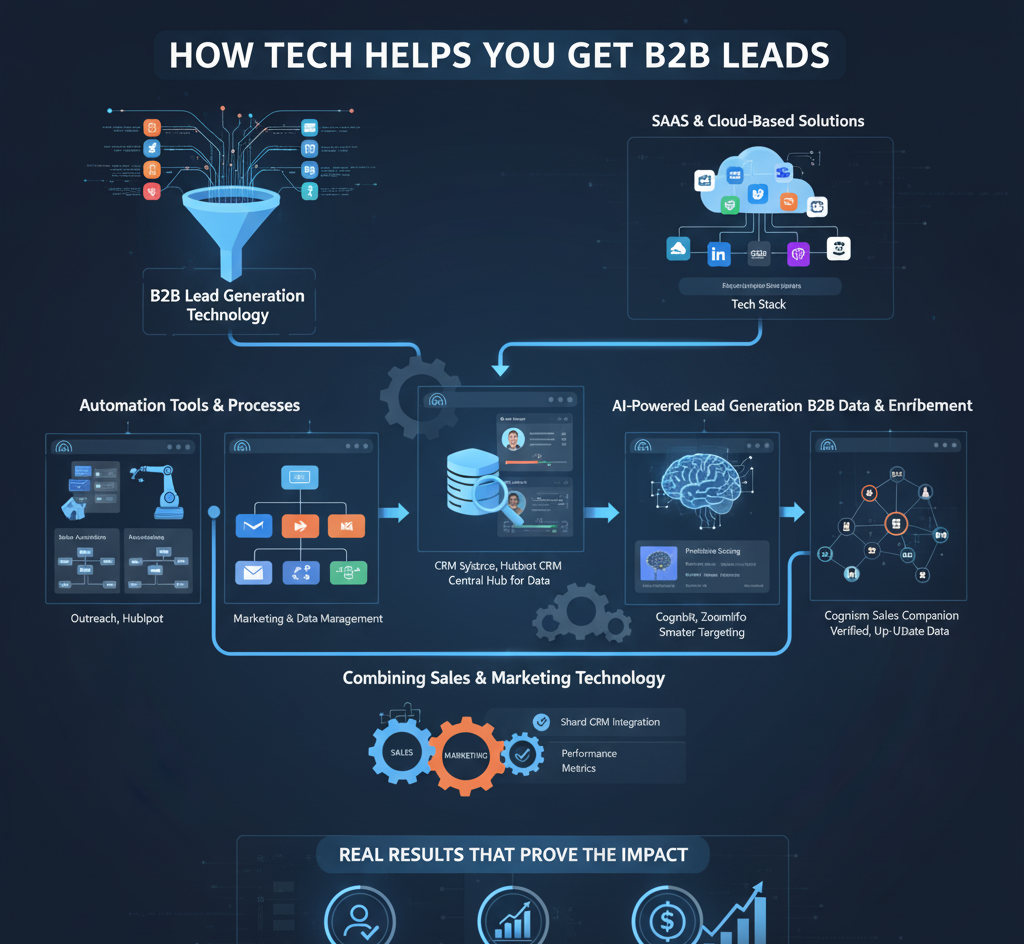
How Tech Helps You Get B2B Leads
Finding new customers is never easy. In B2B sales, it takes time, effort, and the right tools. That’s where technology comes in. Today, most sales and marketing teams rely on digital tools to identify leads, track conversations, and close deals more efficiently.
Having too many options can make things confusing. Which tools actually help? And how do they fit into your process without adding more complexity?
This guide walks you through the main types of technology that support B2B lead generation. You’ll see how each one works, why it matters, and how to choose the right mix for your business.
1. Understanding B2B Lead Generation Technology
B2B lead generation technology refers to the use of digital tools to identify and connect with other businesses that may be interested in purchasing from you.
These tools help you:
- Find prospects that match your ideal customer profile
- Collect and organize their contact information
- Track interactions over time
- Nurture relationships through email, calls, or social media
In short, they make your sales and marketing process faster and more organized. Instead of guessing who might be interested, you can use data to target the right companies at the right time.
2. Automation Tools and Processes
Automation is one of the biggest shifts in B2B sales. It saves hours of repetitive work. Instead of manually sending cold emails or updating spreadsheets, automation tools handle the small tasks so you can focus on actual conversations.
Sales Automation
Sales automation software helps teams reach out to prospects automatically. You can:
- Schedule cold emails and follow-ups
- Set reminders for calls
- Track responses and engagement
Popular tools like Outreach, Apollo, or Salesloft help sales teams manage their outbound activities efficiently. You can see who opened your email, clicked a link, or booked a meeting — all without lifting a finger.
Marketing Automation
Marketing automation tools manage campaigns across multiple channels. Platforms like HubSpot, ActiveCampaign, or Mailchimp let you:
- Send email sequences
- Score leads based on engagement
- Segment audiences for targeted campaigns
Automation doesn’t replace the human touch; it just helps you reach more people consistently. When used right, it feels personal but scales easily.
3. CRM Systems and Data Management
CRM stands for Customer Relationship Management. It’s the backbone of most B2B lead generation processes.
A CRM helps you:
- Store contact information
- Track every call, email, or meeting
- See where each lead is in your sales funnel
- Collaborate with teammates easily
Without a CRM, it’s hard to manage leads as your pipeline grows. Everything gets scattered across spreadsheets or inboxes.
How CRMs Improve Lead Management
Modern CRMs like Salesforce, HubSpot CRM, and Pipedrive do more than store contacts. They analyze your data. They show which leads are most likely to convert and which ones need more attention.
This insight helps sales teams focus their energy where it counts. A good CRM also connects with your marketing tools, so the handoff between marketing and sales is smooth.
Think of it as your central hub, the place where all your lead data lives.
4. SaaS and Cloud-Based Solutions
Most B2B sales tools today follow the SaaS model, short for Software as a Service. This means you access them online, often through a monthly subscription.
The benefit?
You don’t have to install or maintain anything. Updates happen automatically, and your team can log in from anywhere.
SaaS-based tools have made advanced technology accessible to small and mid-sized businesses. You can start with a few licenses and scale as you grow.
Popular examples include:
- HubSpot for inbound marketing and CRM
- ZoomInfo for data and prospecting
- Slack for team collaboration
- Calendly for meeting scheduling
All of these integrate with your main sales tools to form what’s called a tech stack, a collection of software that works together to support your lead generation strategy.
5. Building Your B2B Tech Stack
A tech stack is the full set of tools your company uses to run sales and marketing.
It can include:
- CRM software
- Email marketing tools
- Analytics platforms
- Automation systems
- Data enrichment tools
A good stack doesn’t have to be big. What matters is how well the tools connect.
For example:
- Your CRM stores leads.
- Your marketing automation tool nurtures them with emails.
- Your analytics tool shows which campaigns drive conversions.
Together, these tools form a simple but powerful system.
When building your own B2B tech stack, start small. Pick tools that solve your biggest challenges first. Maybe it’s tracking leads, or maybe it’s finding better contact data. Then, add new tools as your needs grow.
6. AI-Powered Lead Generation
Artificial Intelligence (AI) is changing how companies find and qualify leads.
Instead of manually researching prospects, AI tools can:
- Analyze huge amounts of data
- Identify decision-makers
- Predict which leads are most likely to convert
This saves time and improves accuracy.
For example, AI-powered software can scan LinkedIn or company websites to identify people who match your target profile. It can even personalize email content based on what’s most relevant to them.
Tools like Cognism Sales Companion use AI to help you reach key decision-makers quickly. It pulls verified data, finds contact information, and integrates with your CRM.
You spend less time researching and more time talking to real prospects.
AI doesn’t replace human judgment; it supports it. It handles the heavy lifting so you can focus on strategy and relationships.
7. Sales Enablement and Intelligence Tools
Sales enablement tools give your team the information and resources they need to sell better.
They provide:
- Real-time insights into buyer behavior
- Access to sales content and scripts
- Data that helps personalize outreach
Sales intelligence software, on the other hand, gives you deeper insights into potential buyers’ company size, revenue, recent funding, and more.
This data helps you craft messages that resonate.
For example, if a company just raised funding, you can tailor your message around growth and scaling.
Tools like LinkedIn Sales Navigator, ZoomInfo, and Cognism combine sales enablement with intelligence. They help sales teams stay informed and relevant in every interaction.
8. B2B Data Tools and Enrichment
Good data drives good decisions.
B2B data tools collect and verify company and contact information. They make sure your team always works with accurate details.
Lead enrichment tools go a step further. They add missing details like job title, company size, or LinkedIn profile. This helps your team understand who they’re talking to — and how to approach them.
Accurate data means fewer bounced emails and more meaningful conversations.
When your CRM is filled with verified, up-to-date information, your sales process becomes smoother and more predictable.
Cognism, Clearbit, and Apollo are well-known examples of data enrichment tools in the B2B world.
9. Combining Sales and Marketing Technology
In most B2B companies, sales and marketing work closely together. But sometimes, their tools don’t.
Sales might use one system, marketing another. That creates gaps where data doesn’t flow, and leads slip through the cracks.
The best approach is integration. Your marketing tools should connect directly with your sales systems.
For instance:
- Marketing automation sends qualified leads into your CRM.
- Sales uses the CRM to track and follow up.
- Both teams see the same data and performance metrics.
This alignment helps you measure what’s working, refine your strategy, and close more deals.
When sales and marketing share the same technology stack, they share the same goals, too.
10. Why Cognism Stands Out
There are many tools on the market, but few combine all the elements we’ve discussed: data, automation, and intelligence in one platform.
Cognism Sales Companion is built for modern B2B teams. It helps you:
- Find accurate contact data
- Connect with decision-makers directly
- Integrate with your CRM
- Track performance in real-time
Its AI-powered system reduces manual work and improves lead quality. Instead of chasing cold leads, you get verified data and smarter targeting.
You can even try an interactive demo to see how it works in your workflow.
Cognism isn’t just another lead gen tool; it’s a system designed to make your outreach faster, cleaner, and more effective.
11. Bringing It All Together
B2B lead generation isn’t about having the most tools. It’s about having the right ones.
The right mix of technology helps your team:
- Automate repetitive work
- Manage data effectively
- Personalize outreach
- Make smarter decisions based on real insights
Start small. Build your tech stack one layer at a time. Test each tool. Make sure it integrates smoothly with the rest.
Over time, you’ll create a system that fits your process perfectly. It will save time, reduce errors, and help your team focus on what matters most: building relationships and closing deals.
And that’s what good technology should do: make your work easier, not harder.
FAQ:
How Technology Helps You Get B2B Leads
People ask a lot about tech in B2B sales. It can feel like too much to sort through. Below, I’ve pulled together common questions based on what teams face today. Answers draw from real tools and trends in 2025. No fluff—just clear steps and facts.
What is B2B lead generation technology?
It’s software that finds businesses likely to buy from you. It collects contacts, tracks talks, and sends messages. Think of it as a helper for spotting the right companies and keeping your notes in one spot. Tools like CRM systems or data platforms do this, so you skip guesswork and hit real prospects.
How does automation fit into B2B lead generation?
Automation handles repeat tasks. It sends emails, books calls, or scores leads by how they engage. Sales teams use it for outbound pushes, like sequencing follow-ups. Marketing sets up campaigns that run on their own. The point? You reach more people without extra hours. Tools like Outreach automate cold emails, while HubSpot handles nurture sequences. Start with one simple workflow, like auto-reminders for replies.
Sales vs. marketing automation — what’s the difference?
Sales automation focuses on reps thinking about dialing leads or personalizing outreach. It tracks opens and clicks to time calls right. Marketing automation builds interest first. It segments lists for targeted emails or ads. Both connect, but sales push closes, marketing pulls in crowds. Use sales for quick wins, like Apollo for prospecting. Align them to avoid lost leads.
Why do I need a CRM for B2B leads?
A CRM keeps everything together. It stores names, logs calls, and shows where each lead sits in your funnel. Without it, details scatter emails in one place, notes in another. Modern ones like Salesforce or Pipedrive analyze patterns, like which leads convert best. This lets teams spot hot opportunities fast. For small groups, HubSpot’s free version works fine. Plug it into your email for seamless tracking.
How does a CRM improve lead management?
It turns chaos into a clear view. Add a contact, and it pulls in job titles or company news. Track every email or meeting. See bottlenecks, like leads stuck in “interested.” Hand off from marketing to sales without missing a beat. Pipedrive shines here for simple pipelines. Review weekly to tweak what slows things down.
What are SaaS tools, and why use them for B2B sales?
SaaS means software online, paid monthly. No installs or updates to worry about. Access from anywhere, phone, laptop. It’s flexible for growing teams. Examples: ZoomInfo for prospect data, Calendly for booking demos. They stack with your CRM for a smooth flow. Pick ones that match your size; small teams save with free tiers.
How do I build a B2B tech stack?
Start with basics: CRM for storage, automation for outreach, and data for accuracy. Add one at a time, test how it links up. Your stack might be HubSpot (CRM + emails), plus Cognism (contacts), and Gong (call reviews). Aim for integration; bad connections waste time. List your pains first, like “too many bounces,” then match tools.
What role does AI play in B2B lead generation?
AI spots patterns you miss. It ranks leads by fit, drafts emails, or flags buying signals like site visits. In 2025, its standard tools predict closures with 47% better accuracy. Cognism Sales Companion uses it to enrich data with intent, like recent hires or tech changes. It speeds prospecting but needs good data to shine. Test on a small list first.
What are sales enablement tools?
They arm reps with info scripts, decks, and buyer insights. Pull up a case study mid-call. Tools like Seismic store content; LinkedIn Sales Navigator adds profiles. They cut prep time, letting you personalize better. For teams, pair with intelligence like ZoomInfo for funding news.
How do B2B data tools work for lead enrichment?
They verify and add details. Start with a company name; get emails, titles, and revenue. Enrichment fills gaps, like adding LinkedIn links. D&B Hoovers excels in firmographics. Cognism verifies phones for compliant outreach. Clean data means fewer bounces; aim for 95% accuracy.
Why integrate sales and marketing tech?
Silos kill leads. Marketing qualifies, sales follow up, but without shared views, handoffs fail. Integration lets data flow: MQLs hit CRM alerts. HubSpot does both in one. Track joint metrics like conversion rates. It aligns goals, boosting closeness by 20% in aligned teams.
What makes Cognism Sales Companion different?
It combines data, AI, and workflows. Find decision-makers on LinkedIn or sites, enrich with intent signals (like renewals), and export to your CRM. Reviews praise its speed, reps prospect 2x faster. For 2025, it flags tech replacements, with 60% of buys being renewals. Try the demo; it fits most stacks.
How do I choose the right B2B lead gen tools?
Match to your pains. Need data? ZoomInfo or Cognism. Automation? Outreach. Budget under $100/user? HubSpot free CRM. Test trials run 100 leads, count meetings. Check integrations and reviews on G2. Scale slowly; add AI last.
What’s a good starting tech stack for small B2B teams?
Keep it to three: HubSpot CRM (free, all-in-one), Apollo (affordable data), Calendly (scheduling). Total under $50/month. It covers finding, tracking, and booking without overwhelm.
How has AI in lead gen evolved by 2025?
It’s smarter, predicts intent from web signals, and personalizes at scale. Tools like Cognism now include hiring trends and technographics. Conversion lifts 50% for users. But it’s not set-it-forget-it; review outputs weekly to avoid biases.
Can free tools really help with B2B leads?
Yes, for starters. HubSpot’s free CRM tracks basics. Hunter.io verifies emails cheaply. Uplead filters by title affordably. They handle 80% of needs; upgrade when volume hits 500 leads/month.
How do I measure if my tech stack works?
Track KPIs: leads generated, conversion rate, cost per lead. Tools like Google Analytics tie to revenue. Monthly reviews: Did meetings rise? If not, swap one tool. Aim for a 20% MQL-to-SQL rate.
What are common mistakes with B2B lead tech?
Overbuying starts with two tools, not ten. Ignoring integration data silos wastes time. Skipping training reps underuse features. Fix by piloting small and gathering feedback early.