Every Point Explained — A Practical Guide for Real Results
Category: SEO & Digital Marketing | Reading Time: ~15 min
A semantic SEO expert breaks down every item on the complete SEO checklist — basics, technical, keywords, content, backlinks & local SEO.
Most SEO checklists hand you a wall of bullet points and leave you to figure out the rest. This one is different. Every item on this checklist has a reason it exists — and understanding that reason is what separates people who follow SEO advice from people who actually rank.
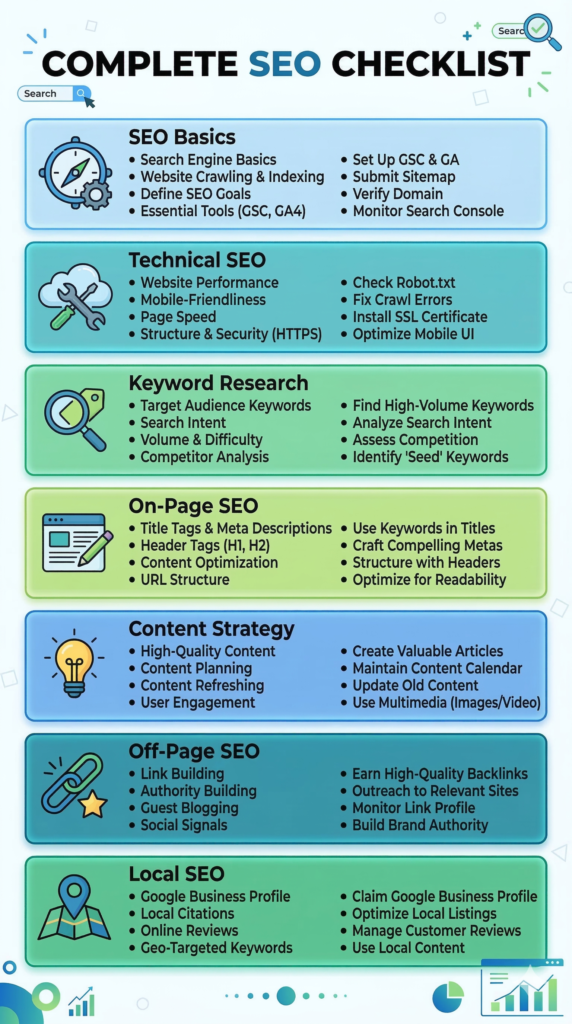
This guide breaks down the complete SEO checklist into seven clear areas: basics, technical, keyword research, on-page optimization, content strategy, off-page, and local SEO. Whether you’re starting from scratch or auditing an existing site, treat this as your go-to reference.
➡ Section 1: SEO Basics — Before Anything Else
Think of the basics as your foundation. You wouldn’t build a house on sand, and you shouldn’t run an SEO campaign without the right tools in place. These aren’t optional extras — they’re the infrastructure that makes everything else possible.
Setting Up Google Search Console & Bing Webmaster Tools
Google Search Console (GSC) is where you go to understand how Google sees your website. It tells you which pages are indexed, what search queries are bringing people to you, and whether there are any crawl errors or manual penalties affecting your visibility. Bing Webmaster Tools does the same for Microsoft’s search engine — which still commands around 6–8% of global search share. Ignoring Bing means leaving real traffic on the table.
| 💡 Pro tip: Connect both tools immediately after launching or acquiring a site. Historical data starts accumulating from day one — you can’t get it back later. |
Setting Up Google Analytics (GA4)
Google Analytics 4 is your behavioural data layer. While GSC tells you how people find your site, GA4 tells you what they do once they arrive — which pages they visit, how long they stay, where they drop off, and whether they convert. Without GA4, you’re operating blind on the post-click experience.
Creating & Submitting an XML Sitemap
An XML sitemap is essentially a roadmap of your website that you hand directly to search engines. It lists all the important URLs on your site, when they were last updated, and how frequently they change. Submitting this through GSC accelerates the discovery and indexing of your pages — especially useful for new sites or pages deep in your site architecture.
Creating a robots.txt File
The robots.txt file sits at the root of your domain and communicates crawling instructions to search engine bots. Use it to block sections of your site you don’t want indexed — staging environments, duplicate parameter URLs, or admin areas. A misconfigured robots.txt can accidentally block your entire site from Google, so review this carefully.
Enabling HTTPS
HTTPS is a confirmed Google ranking signal. Beyond ranking, it’s fundamental to user trust — browsers display security warnings on HTTP sites, which kills conversion rates. If your site is still on HTTP, enabling an SSL certificate should be your very first step before any other SEO work begins.
Setting Up Ahrefs or SEMrush Webmaster Tools
Tools like Ahrefs and SEMrush give you data that Google doesn’t share publicly: backlink profiles, competitor keyword gaps, domain authority metrics, and site audit capabilities. Their free webmaster tools tier gives you enough to get started without a paid subscription.
➡ Section 2: Technical SEO — Making Your Site Work for Search Engines
Technical SEO is about making sure search engines can actually access, crawl, and understand your content. Great content on a technically broken site still won’t rank. Think of technical SEO as clearing the road before you send traffic down it.
Ensuring Pages Are Crawlable & Indexable
Not every page on your site should be indexed — but every page you want to rank must be both crawlable and indexable. Check that important pages aren’t accidentally blocked by robots.txt, noindex tags, or login walls. Use GSC’s URL Inspection tool regularly to verify indexing status on key pages.
Fixing Broken Links & Orphan Pages
Broken links (404 errors) create dead ends for both users and crawlers. They waste your crawl budget and signal poor site maintenance to Google. Orphan pages are equally problematic — these are pages with no internal links pointing to them, meaning Google may never discover or prioritize them. Fix both regularly with a site audit tool.
Removing Redirect Chains
A redirect chain happens when URL A redirects to URL B, which redirects to URL C. Each hop slows down page loading, dilutes link equity, and confuses crawlers. Flatten all chains to a single direct redirect. This is especially common on sites that have migrated domains or changed CMS platforms.
Optimizing Core Web Vitals
Core Web Vitals are Google’s page experience metrics — specifically Largest Contentful Paint (LCP), Interaction to Next Paint (INP), and Cumulative Layout Shift (CLS). These measure real-world loading speed, interactivity, and visual stability. Poor Core Web Vitals scores can hurt your rankings and, more importantly, they frustrate users and increase bounce rates. Use PageSpeed Insights and Lighthouse to identify and fix specific issues.
Mobile-Friendliness
Google uses mobile-first indexing, which means it crawls and indexes the mobile version of your site first. If your mobile experience is broken, stripped of content, or slow, your rankings will reflect that. Test with Google’s Mobile-Friendly Test and ensure fonts, buttons, and layouts are genuinely usable on small screens.
Implementing Canonical Tags Correctly
Canonical tags tell search engines which version of a page is the ‘original’ when duplicate or near-duplicate content exists. They’re essential for e-commerce sites with filtered product pages, paginated content, and any site where the same content appears under multiple URLs. A wrong canonical points equity away from the page you want to rank.
➡ Section 3: Keyword Research — Finding the Right Conversations to Join
Keyword research isn’t about stuffing the most searched terms into your pages. It’s about understanding what your audience is actually asking, at every stage of their journey, and positioning your content to answer those questions better than anyone else.
Finding Primary & Supporting Keywords
Every page should target one primary keyword — the main topic signal you want to send to Google. Supporting keywords are semantically related terms that reinforce topical depth. Think of your primary keyword as the headline and supporting keywords as the subplots. Together, they paint a complete picture of what your page covers.
Long-Tail & Conversational Keywords
Long-tail keywords are longer, more specific search phrases that tend to have lower search volume but significantly higher intent. Someone searching ‘best running shoes for flat feet under $100’ is far more likely to buy than someone searching ‘running shoes’. Conversational keywords mirror natural speech patterns — increasingly important as voice search and AI-driven search interfaces become more prevalent.
Competitor Keyword Gap Analysis
Keyword gap analysis involves finding the keywords your competitors rank for that you don’t. This surfaces low-hanging opportunities where your content can compete without starting from zero. Tools like Ahrefs and SEMrush have dedicated gap analysis features. Focus on gaps where you have existing content relevance — not just any keyword your competitor ranks for.
Mapping Search Intent to Keywords
Search intent is the ‘why’ behind a keyword. Is the user looking to learn something (informational intent), compare options (commercial intent), or buy immediately (transactional intent)? Matching your content type to intent is one of the most impactful things you can do. A product page targeting an informational keyword will always struggle — and vice versa.
Grouping Keywords into Topic Clusters
Topic clusters are groups of semantically related keywords that map to interconnected content pieces. A pillar page covers a broad topic while cluster pages dive deep into subtopics, all linked together. This structure signals topical authority to Google and creates a better navigational experience for users.
Mapping Keywords to Pages & Assessing Ranking Potential
Every keyword should have a home — one specific page optimized to rank for it. Keyword cannibalization happens when multiple pages compete for the same term and split your ranking potential. Prioritize keywords based on search volume, keyword difficulty, and how closely they align with your domain’s existing authority.
➡ Section 4: On-Page SEO — Sending the Right Signals on Every Page
On-page SEO is about optimizing what’s visible — and what isn’t — on each individual page. It’s the place where keyword research meets real content, and where small details make a measurable difference in rankings.
Clean, Descriptive URL Structures
URLs should be short, readable, and include the target keyword. Avoid URLs stuffed with numbers, dates, or parameters where possible. A URL like /best-running-shoes-flat-feet/ tells both users and Google exactly what the page is about before they even click.
Optimizing Title Tags & Meta Descriptions
The title tag is your most important on-page SEO element. It should include your primary keyword, ideally near the front, and stay within 60 characters to avoid truncation in search results. Meta descriptions don’t directly affect rankings but they influence click-through rates — write them like mini ad copy that tells users exactly what they’ll get and why they should click.
H1 Usage & Header Hierarchy
Use one H1 tag per page — it’s your primary heading and should include your main keyword naturally. Follow it with H2, H3, and H4 tags that create a logical content hierarchy. This helps both search engines parse your content structure and helps readers scan for what they need.
Natural Keyword Placement
Keywords should appear naturally throughout your content — in the introduction, a few subheadings, body text, image alt attributes, and the conclusion. Don’t force density. Google’s NLP systems are sophisticated enough to understand context; keyword stuffing actively hurts readability and can trigger over-optimization penalties.
Image Optimization & Internal Linking
Optimize images with descriptive alt text that includes relevant keywords where natural, compress file sizes for faster loading, and use descriptive file names. Internal links are how you distribute page authority across your site and guide users to related content. Every piece of new content should link to and from at least a few relevant existing pages.
➡ Section 5: Content Strategy — Where SEO and Real Value Intersect
Content strategy is where most sites either win or lose long-term. Rankings fluctuate, algorithms change — but content that genuinely helps people builds an audience that keeps coming back regardless.
Solving Real User Problems
Every piece of content should start with a question: what problem does this solve? If you can’t answer that in one sentence, the content isn’t ready. Google’s ranking systems are increasingly designed to surface content that satisfies actual user needs — not content that exists purely to target a keyword.
Strong Introductions & Original Insights
The first 100 words of any article determine whether the user stays or leaves. Lead with the payoff — tell them immediately what they’ll learn and why it matters. Original insights — your own data, case studies, expert opinions, or tested conclusions — are what separate content that earns links from content that gets ignored.
Depth, Structured Headings & AI Extraction
Cover topics in comprehensive depth. Thin content rarely ranks for competitive terms. Use structured headings (H2–H4) that make your content easily parseable by AI systems, LLMs, and Google’s AI Overviews. When sections can stand alone as quotable, self-contained answers, you’re more likely to appear in featured snippets and AI-generated summaries.
E-E-A-T Signals
E-E-A-T stands for Experience, Expertise, Authoritativeness, and Trustworthiness. Google’s Quality Raters use these criteria to evaluate content quality. Build E-E-A-T by publishing author bios with credentials, citing authoritative sources, showcasing real-world experience, and maintaining consistent factual accuracy across your site.
Multimedia, CTAs & FAQs
Include images, infographics, and video where they genuinely add understanding — not as decorative filler. Add clear calls-to-action that guide users to their next logical step. FAQ sections structured with question-style headings are powerful for capturing voice search queries and featured snippet positions.
Content Maintenance — Update, Improve, Remove
SEO isn’t a one-time job. Regularly audit your content: update statistics and outdated information, improve underperforming posts with better depth, and remove or consolidate thin pages that add no value. A leaner site with consistently high-quality content outperforms a bloated site with mixed quality every time.
Voice Search Optimization
Optimize for voice search by writing in natural, conversational language and answering questions directly in your content. Voice queries tend to be longer and phrased as full questions — your FAQ sections, how-to guides, and local content are all prime candidates for voice optimization.
➡ Section 6: Off-Page SEO — Building Authority Beyond Your Site
Off-page SEO is fundamentally about trust signals. The more credible websites that point to your content, the more authoritative your site appears to Google. But quality always beats quantity here.
Building High-Quality Backlinks
High-quality backlinks from relevant, authoritative sites remain one of the strongest ranking signals in Google’s algorithm. Focus on earning links through genuinely valuable content — original research, comprehensive guides, free tools, and expert commentary all attract natural links over time. Don’t buy links. Don’t participate in link schemes. The short-term gains aren’t worth the long-term risk.
Reclaiming Lost & Broken Links
If a high-authority site linked to you and that link now returns a 404, you’re losing equity that was already yours. Use Ahrefs to monitor lost backlinks and reclaim them by redirecting the old URL or reaching out to the referring site. This is one of the fastest ways to recover link value with minimal effort.
Competitor Link Replication & Replacement
Analyze where your competitors earn their links — then pursue the same sources. For broken link building, find cases where competitors’ pages have been deleted and external sites still link to them. Reach out to those sites with your superior, live replacement page. It’s a genuine service to the linking site and a legitimate link acquisition strategy.
Natural Anchor Text & Social Promotion
Your anchor text profile — the clickable text used in links pointing to your site — should look natural. A healthy profile mixes branded anchors, generic phrases, exact match keywords, and partial match variations. A profile dominated by exact-match anchors is a red flag to Google. Distribute content through social media not primarily for SEO value, but to increase visibility and the likelihood of earning organic links.
➡ Section 7: Local SEO — Winning in Your Own Backyard
If your business serves a specific geographic area, local SEO is where you compete for the customers closest to you — and often most ready to buy. It operates on slightly different rules than traditional SEO, with proximity, relevance, and prominence as the three core ranking factors.
Google Business Profile Optimization
Your Google Business Profile (GBP) is the single most important local SEO asset you control. Complete every field — business name, category, address, phone number, hours, services, and photos. Keep it updated. An optimized GBP directly impacts your visibility in Google Maps and the local pack results at the top of local search pages.
NAP Consistency
NAP stands for Name, Address, and Phone Number. This information must be exactly consistent across your website, Google Business Profile, social media, and every directory listing. Even small discrepancies — ‘St.’ vs ‘Street’, different phone formats — can confuse Google’s local algorithms and weaken your local ranking signals.
Local Schema Markup
Adding LocalBusiness schema and service area schema to your site tells search engines precisely what your business does, where it operates, and who it serves. Schema markup helps your information appear in rich results and is a key signal for AI-powered search experiences that synthesize local business information.
Review Generation & Management
Google reviews are a major local ranking factor — both in volume and recency. Build a process for consistently requesting reviews from satisfied customers. Respond to every review, positive and negative. Responses demonstrate engagement and signal to Google that your business is active and attentive.
Local Landing Pages, Citations & Google Maps Embed
Create dedicated local landing pages for each service area you target — each one optimized with location-specific keywords, local references, and unique content. Build local citations on directories like Yelp, Yellow Pages, and industry-specific directories. Embed a Google Map on your contact page — a small trust signal that reinforces your physical presence to both users and search engines.
Final Thought — SEO Is a System, Not a Sprint
The checklist above isn’t meant to be completed once and forgotten. SEO is an ongoing process of auditing, updating, and improving. The sites that win long-term aren’t necessarily the ones with the biggest budgets — they’re the ones that treat every item on this list as a living discipline rather than a one-time task.
Start with the basics. Fix the technical issues. Research your keywords properly. Then build content and links that genuinely deserve to rank. If you do those things consistently, the results follow.
| 📌 Key takeaway: Every section of this checklist is interconnected. Technical health enables crawling. Keyword research guides content. Content earns links. Links build authority. Authority amplifies every other signal. Treat SEO as a complete system and you’ll outperform competitors who treat it as a collection of isolated tactics. |

